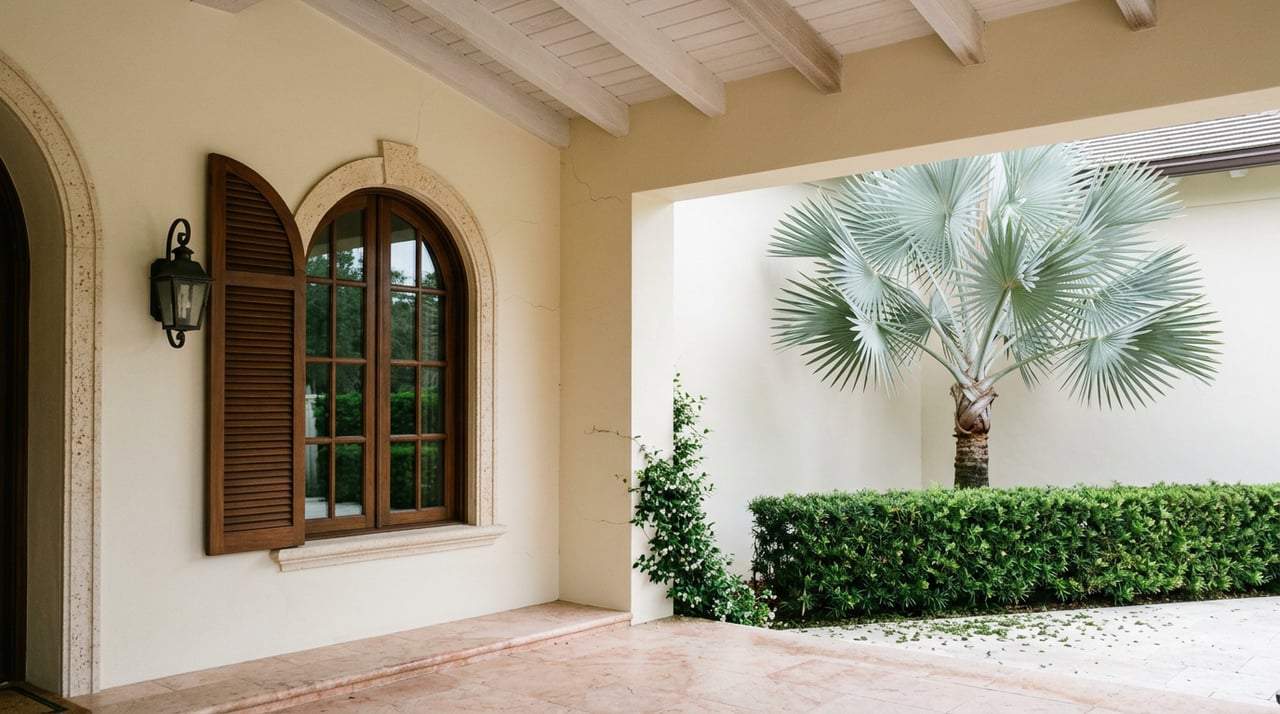
In June 2025, the Coral Gables Code Enforcement Board sat down to a docket that read like a small catalogue of ordinary home improvement. A new roof. Some exterior lighting. A driveway. Nothing that would raise an eyebrow in most Miami-Dade cities. But at 931 and 935 Catalonia Avenue, the work had gone in without permits, and the Coral Gables Gazette reported that the properties, owned by an entity called Biltmore Apartments Owner LLC, faced citations for air conditioning systems, lighting, tile flooring, metal doors, awnings, and the roof itself, all installed without the city's sign-off.
That's the version of this story most people hear about after it's already a problem. The more useful version is the one that explains why it happens so often in this particular city, and what it means for anyone who's about to buy, sell, or renovate here.
The Assumption Most Buyers Make
Ask someone shopping for a home in Coral Gables what triggers extra scrutiny from the city, and most will say the same thing: historic designation. Old house, strict rules. New house, normal rules. It's a reasonable guess, and it's wrong in a way that matters.
Coral Gables runs two separate layers of design oversight. The Historic Preservation Board reviews exterior changes on properties that carry a local historic designation, and that process is exactly as strict as reputation suggests. But the Board of Architects, a citywide body created to keep the city's Mediterranean Revival character intact, reviews exterior modifications on nearly every residential property in Coral Gables, designated or not. The city's own Board of Architects page describes its job as ensuring that development applications meet design standards covering color, materials, proportion, and what the code calls an intrinsic sense of order. That mandate doesn't carve out an exception for a 2019 build on a quiet street with no historic plaque.
In practice this means paint counts. Fences count. Generators count. Artificial turf counts. Window replacements count. Repainting your house the exact same color it already is still requires a submittal, because the Board reviews the choice, not just the change. Applications go in as physical paint brushouts photographed in natural light, not digital swatches, and get compared against an approved palette of roughly 60 earth-tone colors. A typical review cycle runs three to eight weeks, and larger projects often need two to four cycles before final approval.
None of this is secret. It's published, it's been the practice for decades, and it applies to the same degree whether your home was built in 1926 or 2016. What's easy to miss is what happens when a homeowner skips it.
What Happens When Owners Skip It
Coral Gables Code Enforcement operates seven days a week and can refer unresolved violations to the Code Enforcement Board, which has the authority to impose daily fines. Reporting on enforcement activity has put that figure as high as $500 per day, with no cap on how long it can accumulate until the violation is officially closed. Those fines don't stay abstract. Once assessed, they become a lien recorded against the property's title.
That last detail is the one that changes how a buyer or seller should think about this.
A lien from a code violation doesn't attach to the person who did the work. It attaches to the property. It moves with the deed, not the owner.
A buyer's closing attorney in Coral Gables routinely searches the city's permit system before a sale closes, the same way they'd search for any other title defect. An open permit or an unresolved code case surfaces there, and Coral Gables will not issue new permits on a property until the old ones are closed. That can mean a seller scrambling to get an after-the-fact permit approved by both Building and the Board of Architects in the weeks before closing, or a buyer discovering the issue and asking for a credit, an extension, or a way out.
Four Cases, One Pattern
The Catalonia Avenue citations weren't an isolated entry on that June 2025 docket. The same hearing addressed a property at 401 Perugia Avenue, where the owner, listed as Milltower 1905 LLC, was cited for removing city-owned trees without a permit, a violation the Gazette noted carries its own weight in a city that brands itself The City Beautiful and enforces one of the region's stricter urban forestry codes. Another case involved undocumented modifications at a home on Granada Boulevard. A fourth, at 131 Zamora Avenue, involved a designated historic property where windows had been replaced without the required permits or design approval, a violation serious enough to draw Historic Preservation Board review and the possibility of mandatory restoration to the home's original condition.
A separate enforcement docket the previous month included an unpermitted roof repair at a home on Madeira Avenue and an unpermitted gas generator installation on Pizarro Street, both requiring after-the-fact permits before the fines would stop accruing.
Four different streets. Four different kinds of work. The same underlying pattern: someone did exterior work that seemed routine, didn't realize the city's design review applied, and ended up with a violation that had to be resolved through the same process every other Coral Gables project goes through, just with fines and a public hearing attached.
Where This Meets Your Closing Table
If you're buying in Coral Gables, the practical move is to ask for a permit history search as part of due diligence, the same way you'd order a survey or a four-point inspection. That search will show whether any permit on the property is open, expired, or tied to an active code enforcement case. It will not always be obvious from a walkthrough. A fence, a driveway, or a generator installed five years ago by a previous owner can still be sitting there as an unresolved file.
If you're selling, the same logic runs in reverse. Any exterior work done during your ownership, or inherited from the seller before you, is worth checking against city records before you list. A buyer's attorney will find it eventually. Finding it first gives you the option to resolve it on your own timeline instead of the closing timeline, and Coral Gables does offer a path for that: a Special Master hearing can reduce the daily-fine portion of an assessed lien substantially when a homeowner can show the violation was corrected and the noncompliance wasn't willful. That process still takes time, and it works far better when it starts before a contract is signed than after.
For anyone planning a renovation, whether the home is historic or not, the sequence matters. Board of Architects approval needs to happen before a building permit is pulled, not after the contractor has already started. A corrective permit for work already completed still has to satisfy the same design standards as work proposed in advance, which means retrofitting a finished project to an approved palette or an approved fence style is a harder conversation than having it up front.
Before You Make an Offer or List Your Home
A short list worth working through with your agent or attorney:
- Request an open permit and code enforcement search on the specific property, not just a general title search.
- Ask whether any exterior work was completed in the last several years and, if so, whether it received Board of Architects approval as well as a building permit.
- Confirm whether the property carries a local historic designation, since that adds a second review layer through the Historic Preservation Board.
- If you're planning changes after closing, from paint to fencing to a generator, build the Board of Architects timeline into your renovation schedule rather than treating it as a formality.
Frequently Asked Questions
Does Board of Architects review only apply to historic homes? No. It applies to exterior modifications on residential properties across Coral Gables regardless of historic status. Historic designation adds a second, separate review through the Historic Preservation Board.
If I buy a home with an inherited violation, is that my problem now? The lien attaches to the property, not the person who caused it, so an unresolved violation can affect a new owner even if the work happened before the purchase. This is exactly why a permit history search before closing matters.
How long should I plan for if I want to fix a violation before listing? Board of Architects review alone typically runs three to eight weeks per cycle, and a corrective project can take more than one cycle. Add time for Building Division plan check, which commonly runs several more weeks on top of that. Starting early gives you room to close on schedule.
Can a violation actually stop a closing? An open permit or active code enforcement case can complicate or delay a closing, since the city won't issue new permits on a property with unresolved older ones, and buyers or lenders may require the issue resolved as a condition of the sale.
Coral Gables rewards patience with its process and punishes shortcuts around it, and that's true whether the house in question was built by George Merrick's original crews or finished last year. If you're weighing a purchase, a sale, or a renovation here and want a clearer read on what a specific property's permit history actually shows, the team at Brosda & Bentley Realtors can help you look before you leap. Schedule a private luxury consultation and we'll walk through it together.